Showing posts with label books. Show all posts

Saturday, July 06, 2013

2013 Summer reading list


Two unfinished books and two other books that I have just started and look promising. Ya, that should do it for the summer. (Although I am tempted to throw in a classic in the mix - The Brothers Karamazov)

The Elephant Vanishes (Genre: Short Stories)


Thanks to S to recommending this to me. I was already floating in the Murakami world having read his two epic tales - The Wind up Bird Chronicle and 1Q84. Part fantasy, part sci-fi, part Japanese contemporary fiction and whole parts entertainment! I read them in a span of 2 weeks, mainly because I couldn't umm, put them down. This happened to me after a really long time. I don't remember when I strongly felt like this for fiction - I had stopped reading fiction and now am catapulted into the genre again, thanks to Murakami.

So I was happy (and surprised) at The Elephant Vanishes which is Murakami's collection of short stories :-) Sample one of my favorite stories from the book, on S's blog - On seeing the 100% Perfect Girl


Stephen King on Writing (Genre: Non-fiction)


Part autobiography and part advice on the craft of writing, this book is turning out to be such a required reading. With fascinating insights into his own process of writing, who else but Stephen King can pull together a powerful book on the practice and skill of writing. This one is for keeps. I am definitely grabbing my own copy soon.


A Fine Balance (Genre: Indian fiction)


I am not sure how I let this masterpiece pass me :-) I have heard too many good things about this Rohinton Mistry book. It specially interests me since I love Indian fiction spinned around historical and political events. As a kid, I have heard stories about the 1970's emergency period in India from my dad and it intrigued me. I am determined to read through this and it has been a gripping narrative so far.


The Price of Inequality (Genre: Non-fiction, Economics)


A day doesn't go by without a reference to the rising inequality in India. And after so many powerful videos made on what inequality actually means and why we should care, I wanted to read more and understand it better. Specially because India is hanging in such a dangerous balance right now, I am taking upon myself to read this book and hopefully explain/share what I learnt once I am done reading.

As one Amazon review reads: 

One sentence basically says it all: "The top 1 percent of Americans gained 93 percent of the additional income created in the country in 2010, as compared with 2009." Now think of that in terms of a party with 100 people and big pizza with 100 slices. Basically it means that one rich guy gobbles up 93 slices of pizza. The other 99 get to divvy up the other seven.

Friday, June 14, 2013

What I am reading this weekend


My Pocket reading queue needs a summer cleaning. So what better way than to systemically get my reading done on weekends - archive the good ones for re-reads and toss out the bad. And along the way, I can suggest the cherry-picked ones for you to read :-)

How to give a killer presentation - by Chris Anderson, curator of TED. If you want to read one single useful article this week, make it this. Packed with all the TED goodness and more importantly timeless advice on pimping your presentation skills.

The scientific 7 minute workout - featured in New York Times wellness section. I try to clock in a similar routine, 30 mins each, three times a week. I stopped using weight machines since 2009 and only do free weight exercises. This is all you need to get a lean, fit body with super endurance and kicking metabolism (I guess nobody listens until something goes viral :)) Give it a shot!

The importance of quick and dirty - by Jason Fried of 37Signals. This is a brief article on how the speed of iteration beats the quality of iteration in software development. Something I talked about in an earlier blog on The Simple Rules to Winning Dogfights

Dear Leader Dreams of Sushi - featured in GQ; a gripping story of a Japanese chef who served North Korea's dictator Kim Jong-il. This almost read like a contemporary fiction replete with power, women, threats, secrets and other royal extravagance. Must read.

Are coders worth it? - a well-written piece in Aeon magazine. I always get asked this question by my parents - "Why are programmers paid so much?" and this article is the answer to it or rather part of the answer to it.

Brotherly Love - by Jhumpa Lahiri in The New Yorker's summer fiction issue, on two brothers growing up in the 1960's Calcutta, India; an excerpt from her forthcoming novel "The LowLand"

What are you reading this weekend?

Friday, May 24, 2013

The simple rule to winning dogfights


Below is an excerpt from Jeff Atwood's Effective Programming: More than Writing Code. This book is basically a collection of his blog posts on Coding Horror. If you are lazy like me this book is a one-stop shop for the best programming advice culled from his blog. In short, gold mine for all programmers.

In this excerpt, he drills the value of iterating faster and speed of execution (this is a universal law, in nearly every field - software development or otherwise):

Boyd's Law of Iteration: Speed of iteration beats the quality of iteration

Boyd decided that the primary determinant to winning dogfights was not observing, orienting, planning or acting better. The primary determinant to winning dogfights was observing, orienting, planning and acting faster. In other words, how quickly one could iterate.  

Speed of iteration, Boyd suggested, beats the quality of iteration.

Speed of iteration - the Google Chrome project has it.

1.0 Dec 11,2008
2.0 May 24, 2009
3.0 Oct 12, 2009 
4.0 Jan 25, 2010
5.0 May 25, 2010
6.0, Sep 2, 2010

Chrome was a completely respectable browser in V1 and V2. The entire project has moved forward so fast that it now is, at least in my humble opinion, the best browser on the planet. Google went from nothing, no web browser at all, to best of breed in under two years. Meanwhile Internet Explorer took longer than the entire development period of Chrome to go from version 7 to version 8. And by the time IE 9 ships, it will be completely outclassed by both Firefox and Chrome.

....
....

So until further notice, we will be following the same strategy as the Android and Chrome teams: We are going to go that way, really fast. And if something gets in our way, we will turn.

Larry Page responds on high correlation between speed and good decisions:
"There are good fast decisions but no good slow decisions"

Cheers to that!

Thursday, July 05, 2012

The art of letting go..


..is a lost art in adults. A known fact that as we morph from a child to an adult we severely restrict our ability to let go and imagine the unimagined. We ridicule and fear any invention. We like to be in our comfort zone and not step onto other's feet. We continuously train ourselves to live within constraints, lest we embarrass ourselves in public.

In a true adult fashion, I started to think analytically about how I can revive or atleast let a part of me go uninhibited. It's this resistance of the brain, refusing to let go. How can I free myself from the fear of making myself a fool? I don't have an answer to this.

Perhaps I must keep reading this excerpt from the book Imagine to inspire me every day, on days when I feel I could have done something - only if I let myself wander, if I let go...

World renowned American cellist Yo-Yo Ma echoes this idea.

"When people ask me how they should approach performance, I always ask them that the professional musician should aspire to the state of the beginner," Ma says. "In order to become a professional, you need to go through years of training. You get criticized by all your teachers, and you worry about all the critics. You are constantly being judged. But if you get onstage and all you think about is what the critics are going to say, if all you are doing is worrying, they you will play terribly. You will be tight and it will be a bad concert. Instead one needs to constantly remind oneself to play with the abandon of the child who is just learning the cello.

Because why is that kid playing? He is playing for pleasure. He is playing because making this sound, expressing this melody, makes him happy. That is still the only good reason to play"


Saturday, June 30, 2012

The act of kindness - an essential trait of leadership


I generally listen to stories - about random acts of kindness. It lasts only that much longer though. It fails to "stick". Suddenly when someone notable or powerful speaks, your ears perk up and you take to their advice and give full attention. It so happened I was privileged enough to sit in an auditorium brimming with co-workers listening to Colin Powell speak. Now I expected a more military-government-defense sort of serious talk.

Now imagine my surprise when he spoke a lot more about kindness than what would be expected from a personality and leader like him. He came across as the most down to earth, ordinary and an honest, straightforward guy and yet he arrested my attention!

Among several great anecdotes he narrated, one stuck with me till date and will do forever. I started reading his book It Worked For Me : In Life and Leadership today and I was pleased to see the same anecdote in one of the chapters. 

Bottomline being kindness is essential for rock solid leadership.
Read why in this excerpt from the book - 

When I was Secretary of State, I slipped away one day from my beautiful office suite and vigilant security guards and snuck down to the garage. The garage is run by contract employees, most of them immigrants and minorities making only a few dollars above minimum wage.

The garage is too small for all the employees' cars. The challenge every morning is to pack them all. The attendants' system is to stack cars one behind the other, so densely packed that there's no room to maneuver. Since number three can't get out until number one and two have left, the evening rush hour is chaos if the lead cars don't exit the garage on time. Inevitably a lot of impatient people have to stand around waiting their turn.

The attendants had never seen a Secretary wandering around the garage before; they though I was lost. (That may be true by then, but I'd never admit it.) They asked if I needed help getting back "home".

"No", I answered. "I just want to look around and chat with you."

They were surprised, but pleased. I asked about the job, where they were from, were there problems with carbon monoxide, and similar small talk. They assured me everything was fine, and we all relaxed and chatted away.

After a while I asked a question that puzzled me: "When the cars come in every morning, how do you decide who ends up first to get out and who ends up second and third?"

They gave each other knowing looks and little smiles. "Mr. Secretary", one of them said, "it kinda goes like this. When you drive in, if you lower the window, look out, smile and you know our name, or you say 'Good morning, how are you?' or something like that you are number one to get out. But if you look just straight ahead and don't show you even see us or that we are doing something for you, well, you are likely to be one of the last to get out."

I thanked them, smiled, and made my way back to where I had abandoned my now distraught bodyguard. 

At my next staff meeting, I shared this story with my senior leaders. "You can never err by treating everyone in the building with respect, thoughtfulness and a kind word," I told them. "Every one of our employees is an essential employee. Every one of them wants to be viewed that way. And if you treat them that way, they will view you that way. They will not let you down or let you fail. They will accomplish whatever you have put in front of them."

Thursday, June 28, 2012

The Best of Nora Ephron


Nora Ephron was one filmmaker whose storytelling was irresistibly whimsical. It influenced me deeply when I was a kid. She, I think, re-defined the concept of rom-coms (romantic comedies). It made you tear up. It made you love life. It made you bundle those moments of joy and curl up with them. It made every thing sound and look beautiful. Even heartache was presented in wit and humor. I was so besotted by her master storytelling that I would read up her movie screenplays - something I have never done of any other filmmaker's, till date. And to date, I reread some of her non-fiction pieces in The New Yorker - her writing is an eclectic blend of humor, old-fashioned charm, optimism and spirit. 


The last movie I saw of hers - Julie & Julia - reminded me of how fond I was of food and cooking, no matter how amateur a cook I am. She took the otherwise mundane scenes and turned them around into remarkable memories. Who would have thought that the scene in When Harry met Sally where Sally drops off Harry at the Washington Square Park arch would be so iconic?

Those are the magic moments of storytelling & cinema - when you look at a scene and it sticks and you wish you lived it!

RIP Nora Ephron.

Here are some of the best articles I have read on Nora Ephron -


(Recommended) All the wonderful pieces Nora wrote for The New Yorker

(Recommended) One of the best comedy scenes in a Nora Ephron movie - The Heartburn - starts at about 0:57 via @MindyKaling


Mindy Kaling walks through her favorite movie - You've Got Mail

(Recommended) Nora Ephron on women, love, happiness, reading, life and death via @brainpicker

And if you are already not overdosed yet, all the #longreads on Nora Ephron :)

And my favorite line of hers:

“Above all, be the heroine of your life, not the victim.”

Tuesday, June 12, 2012

When in doubt, trust a computer algorithm (aka The Myth of Intuition)


Call it karmic interference. I have been reading this book and a myriad of articles in the last few days that gave examples on debunking the myth of intuition. Yes, intuition is not universally applicable.

Consider this example I read in today's New Yorker article by Jonah Lehrer on why smart people are stupid:


In a lake, there is a patch of lily pads. Every day, the patch doubles in size. If it takes 48 days for the patch to cover the entire lake, how long would it take for the patch to cover half of the lake
?

Your immediate response is 24 days. Now if you were like me, you would think that was too quick an answer. Then slowly Geometric Series strikes you. And if you were still like me, you would think that writing a formal equation to solve this is simply too complex. There must be an easier way of reasoning this out. 

So you just take a smaller example. Say it takes 2 days to cover the lake, what would your answer be then? 1 day. Similarly for 48 days, it must just be the day before. So the answer is actually 47 days.

Whew. That took some thinking. But wonder why your brain seeks out a shorter route each time?

Daniel Kahneman in his book Thinking fast and slow discusses such an innate weakness of the human brain that is wrongly dubbed as "intuition". Slow deliberating thinking is hard work whereas quick impulsive thinking is lazy. In fact, there is sufficient evidence that procedural way of thinking can be superior to human reasoning when it comes to predictions. And so in his book, he says: When in doubt it is better to trust a computer algorithm. Atleast they can't perform worser than intuitive judgements made by humans in such cases.

Also makes me wonder aloud about the power of Geometric Series in general. An amusing story I came across in this book on micro lending is just the perfect example to demonstrate the power of Geometric Series and our lack of misgivings while making a judgement in such cases:

The story goes like this: a prisoner who was condemned to death was brought before the king and was asked to make a last wish. The prisoner pointed to the chessboard which was to the right of the king’s throne, and he said, ‘I wish only for a single grain of rice on one square of the chess-board, and that you double it for each succeeding square.

‘Granted,’ said the king, not realizing the power of geometrical progression. For soon the prisoner had the entire kingdom. 


So if you really get down to solving the geometric series the prisoner gains 2^64 -1 which is 1.8 x 10^19 grains. And this is (to give you a scale of comparison) more than the total number of grains of sand on Earth! (which is 7.5 x 10^18)

That brings me to the lily pads example above as well. After 48 days, you have about 2^48 lily pads (even if each pad is about 10 cm in diameter, so about 75 sq. cm in area) that covers about 75 * 2 ^ 48 sq cm area which is about 2 million sq. km.  That is one big ass lake! (largest lake is about 371 sq km only, the Caspian Sea)

Moral of the story: Obvious is too obvious. Think stupid to break out of the bias :-)


Tuesday, May 22, 2012

The Bus to Abilene


Sitting in the noisy, crowded and almost nauseating hospital hallway today, I found respite in an audiobook - Quiet: The Power of Introverts in a World That Cant Stop Talking.

Among the several insightful and captivating anecdotes in the book, the following struck an instant chord with me. The Bus to Abilene is a parable about how we tend to follow the first person to speak up in a group - irrespective of whether he is right or wrong in the given context. It is imperative on us to weigh the pros and cons of the initiative and reach an accurate judgement or we risk getting on to The Bus to Abilene (i.e blindly following someone's initiative)

An excerpt from the book illustrates the anecdote (replicated here as best as I could from the audiobook):

The Bus to Abilene. Any army officer can tell you what that means. It's about a family sitting on a porch in Texas on a hot summer day and somebody says, "I am bored. Why don't we go to Abilene?" When they get to Abilene, somebody says, "You know, I didn't really want to go". And the next person says, "I didn't want to go - I thought you wanted to go" and so on.

Whenever you are in an army group and somebody says "I think we are all getting on the bus to Abilene here", that is a red flag. You can stop a conversation with it. It is a very powerful artifact of our culture.

The Bus to Abilene anecdote reveals our tendency to follow those who initiate an action - any action.

Sidenote: It is quite amusing how such interesting phrases or lines refer to the state of Texas. One such line is All hat no cattle - meaning a person who is all talk and no substance (an indirect dig at people who wear hats like cowboys but may not exactly have the experience on a ranch)

Tuesday, May 01, 2012

The Story behind Gatorade


Half way through the book Reverse Innovation and I am so tempted to continue reading. Except, there is a such a world where reading is not all what you do :-)

This book has got me hooked primarily since the author speaks on a theme that I completely believe in. That is, innovation is not bound to happen in only rich economies but in fact, it flows uphill from the developing to the developed world. Either organizations are blind or they simply don't want to take risk, if they disagree with this concept. And that is why it is so important that such a well-researched book built on real world case studies and practical strategies to leverage this trend, should and must be one of the books in a CEO's arsenal.

Right from Mohammad Yunus's Microfinance concept to Mahindra & Mahindra establishing themselves as world leaders in tractor manufacturing manifest this serious belief. 

And an interesting excerpt about how Gatorade came to be because of a discovery that took place in Bangladesh, is eye-opening.

Excerpt from the book:

Gatorade. It is as American as baseball and apple pie.

Its 1960s roots can be traced back to the sun-scorched University of Florida and its football team - the Gators. Oppressive heat and humidity led the team's trainers to seek better ways than water alone to quickly rehydrate players. They turned to the school's research labs, which came back with a concoction of water, glucose, sodium, potassium, and flavorings. The tasty cocktail sped the replenishment of the electrolytes and carbohydrates that players lost through sweat and exertion.

Even before it became an actual brand, Gatorade got a nice marketing boost from the coach of Georgia Tech. Asked how the team had lost to Florida in the 1967 Orange Bowl, he lamented, "We didn't have Gatorade."

It is a great story, and it is wonderfully fitting for an American icon. But there is an interesting missing link, one that leads back to events far from Gainesville, Florida.

Earlier in the 1960s, there were epidemic outbreaks of cholera in Bangladesh and elsewhere in South Asia. The key to keeping cholera patients alive was simple: keep them hydrated.

According to Mehmood Khan, chief scientific officer of PepsiCo (which bought Gatorade in 2001), Western doctors who went to Bangladesh and elsewhere to help stem the epidemic were surprised to discover a centuries-old treatment for the severe diarrhea caused by cholera. The concoction included ingredients such as coconut water, carrot juice, rice water, carob flour, and dehydrated bananas. At the time, Western medical opinion held that putting carbohydrates in the stomachs of patients suffering from diarrhea would cause cholera bacteria to multiply and the disease to worsen. "Yet for thousands of years, this was the normal treatment used in Ayurvedic medicine", says Khan. "By giving carbohydrates and sugar in the solution with salt, uptake was quicker, and patients rehydrated faster."

The success of the treatment was covered in the British medical journal Lancet and made its way to a doctor at the University of Florida. The doctor saw a common problem in the need for rapid rehydration. If such a treatment worked well for cholera patients, it would surely work for healthy football players. 

The Gatorade story was unusual for its era. It ran counter to the dominant innovation pattern. Innovations typically originated in rich countries and later flowed downhill to the developing world. Gatorade, by contrast, swam against the tide. It was a reverse innovation.


Sunday, March 11, 2012

Burying the lead


Burying the lead often occurs in journalism. This is a problem of how journalists stray away from reporting the most important point of a story. However this is a phenomenon that occurs in our everyday non-journalist lives as well. We often miss the core of an idea, message, work etc. that we are involved in.

I found the following book excerpt from Made to Stick (a book everyone must read) to be a profound illustration of this concept, that it instantly stuck with me. I am tempted to share it here:

Nora Ephron is a screenwriter whose scripts for Silkwood, When Harry Met Sally and Sleepless in Seattle have all been nominated for Academy Awards. Ephron started her career as a journalist for the New York Post and Esquire. She became a journalist because of her high school journalism teacher.

Ephron still remembers the first day of her journalism class. Although the students had no journalism experience, they walked into their first class with a sense of what a journalist does: A journalist gets the facts and reports them. To get the facts, you track down the five Ws - who, what, where, when, and why.

As students sat in front of their manual typewriters, Ephron's teacher announced the first assignment. They would write the lead of a newspaper story. The teacher reeled off the facts:

"Kenneth L. Peters, the principal of Beverly Hills High School, announced today that the entire high school faculty will travel to Sacremento next Thursday for a colloquium in new teaching methods. Among the speakers will be anthropologist Margaret Mead, college president Dr. Robert Maynard Hutchins, and California governor Edmund 'Pat' Brown."

The budding journalists sat at their typewriters and pecked away at the first lead of their careers. According to Ephron, she and most of the other students produced leads that reordered the facts and condensed them into a single sentence:

"Governor Pat Brown, Margeret Mead, and Robert Maynard Hutchins will address the Beverly Hills High School faculty Thursday in Sacramento...."

The teacher collected the leads and scanned them rapidly. Then he laid them aside and paused for a moment.

Finally he said, "The lead of the story is 'There will be no school next Thursday.'"

"It was breathtaking moment", Ephron recalls. "In that instant I realized that journalism was not just about regurgitating the facts but about figuring out the point. It wasn't enough about to know the who, what, when, and where; you had to understand what it meant. And why it mattered."

Thursday, March 08, 2012

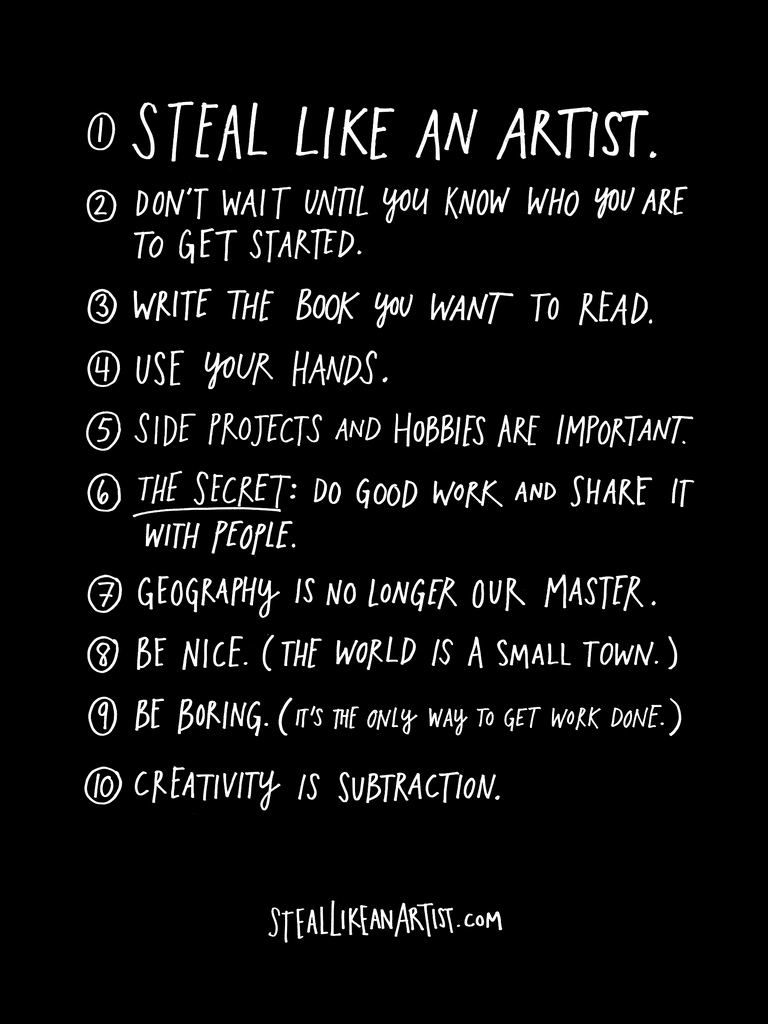
Steal like an Artist


We have all heard about that one before :-)

This happens to be the title of a new book I am going to pick up for some quick reading this week. It is by a guy called Austin Kleon, who lives in Austin (duh!) and whose bio reads "I'm a writer who draws". Yes, he got me at his bio. His earlier projects included The Newspaper Blackout - how he used a sharpie to blackout words and create poetry out of newspaper text :-)

This is one of the talks he gave at The Economist where he speaks of how artists steal (the right way of course).

"We can pick our teachers and we can pick our friends and we can pick the books we read and the music we listen to and the movies we see, etcetera. You are a mashup of what you let into your life."


And an awesome poster from his book that caught my attention.
So what are you going to steal today?

Courtesy: brainpickings.org

Wednesday, February 22, 2012

The Curse of Knowledge


Yes, sometimes I get deeply thoughtful about stuff like that. Not kidding.

So currently I am reading Made to Stick and this is an excerpt from the brilliant book on the curse of knowledge (it is easy to follow, I promise;-) And also since I am in the mood to throw this stuff at you, you got no choice.):

In 1990, Elizabeth Newton earned a PhD in psychology at Stanford by studying a simple game in which she assigned people to one of two roles: "tappers" or "listeners". Tappers received a list of 25 well-known songs such as "Happy Birthday to You" and "The Star Spangled Banner." Each tapper was asked to pick a song and tap out the rhythm to a listener (by knocking on a table). The listener's job was to guess the song, based on the rhythm being tapped. (By the way, this experiment is fun to try at home if there's a good "listener" candidate nearby)

The listener's job in this game is quite difficult. Over the course of Newton's experiment, 120 songs were tapped out. Listeners guessed only 2.5% of the songs: 3 out of 120.

But here's what made the result worthy of a dissertation in psychology. Before the listeners guessed the name of the song, Newton asked the tappers to predict the odds that the listeners would guess correctly. They predicted that the odds were 50%.

The tappers got their message across 1 time in 40, but they thought they were getting their message across 1 time in 2. Why?

When a tapper taps, she is hearing the song in her head. Go ahead and try it yourself - tap out "The Star Spangled Banner". It's impossible to avoid hearing the tune in your head. Meanwhile, the listeners can't hear the tune - all they can hear is a bunch of disconnected taps, like a kind of bizarre Morse Code.

In the experiment, tappers are flabbergasted at how hard the listeners seem to be working to pick up the tune. Isn't the song obvious? The tappers' expressions, when a listener guesses "Happy Birthday to You" for "The Star Spangled Banner," are priceless. How could you be so stupid?

It's hard to be a tapper. The problem is that tappers have been given knowledge (the song title) that makes it impossible for them to imagine what it's like to lack that knowledge. When they're tapping they can't imagine what it's like for the listeners to hear isolated taps rather than a song.

This is the Curse of Knowledge. Once we know something, we find it hard to imagine what it is like not to know it.

Sunday, February 19, 2012

Book review: Is Everyone Hanging Out Without Me (and other concerns)


First, lookup Mindy Kaling. If you have identified her from The Office, good job. I just feel she should come on screen more often. Of course, I am also happy if she just keeps writing books like this one - Is Everyone Hanging Out Without Me (and other concerns). If you want a flavor of this book, read this New Yorker piece she wrote - a funny take on the state of chick flicks. Not surprisingly, it also happens to be one of the chapters in the book :-)


It takes a certain kind to write this book - unabashedly funny, over-the-top sarcasm and loving to degrade oneself for the sake of laughs. All traits of a good comedian. Now, intertwine that with sassy humor and real-life events, with some girly fun thrown in here and there. That takes it up a few notches. Mindy Kaling (aka Vera Mindy Chokalingam) has arrived.

Comparisons with Tina Fey's Bossy Pants are inevitable, but having read both I am happy to say that the comparison ends there. The book stands on its own. She comes across as this cute, funny best friend that girls want to have. There is nothing more successful than a book that connects with a certain type of audience. I am sure the guys would love this book too. It is more about comedy than say a girl's fashion black book. But a girl, she will love it. So if you are guy who has a funny girlfriend, this is the book she will enjoy reading and love you even more for gifting it to her ;-)

Some of the chapters were laugh out loud. For instance there is one entire chapter on her long and vivid revenge fantasies that she imagines during workouts. Easily one of my favorite chapters.

Like I said, it takes a certain kind.


Wednesday, February 08, 2012

Book review: Last Man in Tower


For a really long time I wanted to read an Indian book by an Indian author. You know what I mean. Not the pseudo Indian stuff, but something I can relate to. And definitely NOT Chetan Bhagat. Sigh.

Having grown up in a middle class family and lived (for a few years - but the best ones!) in a chawl I took to Last Man in Tower like a fish takes to water (Yes, I had to throw in a cliche there;))

Pic courtesy: Amazon.com book cover


I read Aravind Adiga's The White Tiger long ago. For some odd reason, I wasn't impressed by it. And now I know why. Methinks it is the way he symbolizes circumstances and people in his story and depending on how well you follow these through the thread of the story gives you the maximum pleasure. It is like reaching a crescendo but without much ado about it. You know, like a good detective novel. If I described Last Man in Tower to be a suspenseful story, there will no laughing about it. It is a suspense filled drama! Like the Indian soap operas, but taut and better :-) (Ok I shouldnt have compared to Indian soap operas. Let me rephrase. It is like those characters in a story that become endearing to you. Ya, that's what I meant. Good.)

The way Aravind Adiga sketches the characters in the book is so believable. It makes you sit up and say "Hey I know this guy!" or "Hey, that is like my neighbor X"

Last Man in Tower is all about greed driving middle class people crazy evil. And that is in a nutshell what the book is about. If you were ever in a middle class family or in poverty or...you know anything except the elite, you will relate to this story :-) If you grew up in an apartment building or in a chawl you will totally suck it up. Oh, and for people from Bombay, you will enjoy it immensely! (Hopefully someone writes about Hyderabad soon)

In fact, I might pick up The White Tiger for a re-read. I am caught in the Adiga wave now.

PS: Oh as always, the book isn't thick, so it is an easy read. Just go slow and don't skip some of his subtle symbolisms of Indian life, it will really give you an appreciation of both the beauty and ugliness of Indian life.


Wednesday, September 21, 2011

Smell.o.licious


I miss the smell of books. Seriously.

Ever since I moved to the West Coast, a day hasn't passed when I haven't thought about NYPL
It was my Mecca. My sanctum. And all those wonderful feelings I got when I had a stack of them.
Wonder why NYPL cant open like an ex-New Yorkers branch. *Sigh*

No seriously, f*** kindle. It isn't cutting it man. I tried reading through it on the bus to work. It either gives me a headache or just makes me want to nap rather.

In fact one of the prime reasons that I am so against moving and relocating is having to leave behind a long trail of books. Boo hoo.

Recently, I have been whining a lot. A hell lot. And then today I got nostalgic for some odd reason. I saw someone (for a change) reading hardcover fiction and it took me back to the time when I used to walk to the humble library, couple of blocks from my home. I owned exactly 2 pieces of shirt and one light green skirt. And you know how I felt then? Like the luckiest girl in the whole damn world. Lucky because I got this whole freaking library and I wanted to live there. And read them all up. Not once was I embarrassed about wearing the same skirt over and over again.

Obviously, my dad was very taken aback by this attitude. I would beg, plead, cry, threaten, wallow...so long as my dad paid my library membership fee. I never once asked him to get me some clothes instead. That really bothered him. LOL.

I used to watch the kind of people coming in and out of the library.

The socialites would choose all the glamor and celebrity magazines.
Girls at call centers would come by for Mills & Boon
Teenagers would gawk at Nancy Drew, Hardy Boys and Sidney Sheldon.
The thriller fans head toward Agatha Christie.
And the more sensible (like me;) would read classics =)

But I tried every one of them. Books were my sanctum sanctorum. My whole world revolved around them.

Wait. I remember this one book. It was a "holy shit this is huge" sort of book. I can't seem to remember its name. It was filled with how stuff works. What the hell was it? I cant remember it now. I was so fascinated. I lugged the giant thing home and spread it on the floor and read it.

I still remember my library card number. And yes, the library still exists. And my card is still there, as of  last November=)


Friday, August 12, 2011

Poke the Box: When was the last time you did something for the first time?


I am sucker for Seth Godin's books and essays.
Poke the Box is his recent manifesto about starting.
I know I know. I am not going to listen to you, lol.

I just love reading and re-reading his books for the insightful stories he shares and how short and pithy he keeps it. But mind you, if you are looking for a how-to book, this isn't for you. There are other books of his, that do a better job at that. This is sort of like a poster, you can stare at and ruminate about what you are going to start..now.

In his own words:

Starting a project, making a ruckus, taking what feels like a risk.


Not just, "I'm starting to think about it" or "we're going to meet on this", or even "I filed a patent application..."


No, starting.


Going beyond the point of no return.


Leaping.


Committing.


Making something happen.

The job isn't to catch up to the status quo. The job is to invent the status quo.

Monday, August 01, 2011

Monkey business


On days when I am overwhelmed, I set aside everything that is overwhelming me, fish a book and walk out to find a lonely spot to read. I am not sure if that is a nice way to overcome overwhelming tasks, but seems to work  for me. So for the past week I have been reading the manifesto style "The Art of Non-Conformity" by Chris Guillebeau (this dude is awesome!) If anything, this guy should pay me for I have influenced atleast a dozen New Yorkers this week on the subway, brandishing the book at their face. If you keenly observed New Yorkers they dont give a shit, really. No matter what you do. You might make sounds, fall on your face or even roam around pantless on the subway and they will not as much as raise an eyebrow at you. As if to say, "Like seriously, you thought that was the weirdest thing to do? Grow up!"

Anyway, so the point I am trying to make is - New Yorkers wont bat an eyelid until you are hooked on a book and then they want to watch the book cover to see what got you hooked so badly. Yeah. No kidding. I have many a times based my choice on dear New Yorkers book choices. Each one radically different. The joys of a subway travel.

Now if you have read this far and survived, you would ask me why the title reads "Monkey Business". That's because instead of a traditional book review I chose to quote this story from the book. I am sure you have heard this tale in one form or the other (amazing how many variants you have for a story that has a moral in the end). Definitely a good book if you want to get a shot of inspiration.

The Art of Non-Conformity: Set Your Own Rules, Live the Life You Want, and Change the World


 And now, ladies and gentleman, the monkey business...

"Five monkeys are thrown in a cage by a sadistic monkey-hater. Enough food and water is available at the bottom of the cage, saving them from starvation while forcing them to lead a boring life of staring  through the glass every day. The food at the bottom is bad, but sufficient. At the top of the cage, however, a large stalk of bananas alluringly waits. Conveniently, a ladder to the top has been provided by the sadist.


After getting over the shock of being caged, one of the monkeys scales the ladder and reaches for a banana. All of a sudden a fire hose appears from nowhere. The monkey at the top of the ladder is soaked with cold water but not only him - all of the other monkeys are soaked as well, in an exercise of group punishment for the sins of one freedom-loving monkey.


Over the next few days the experience repeats itself several times. One monkey makes a run for the bananas, the whole troop of monkeys gets soaked, and pretty soon the group starts beating up the monkey brave enough to scale the ladder. The bananas are still at the top, but just out of reach. The monkeys reluctantly accept the fate of living a life without bananas.


Then one day the experiment changes...


The sadist takes one monkey out of the cage and replaces him with another one. Not knowing the consequence of being doused with the cold water, the new monkey immediately begins to scale the ladder in pursuit of a banana, the rest of the monkeys pull her down before she reaches the top, and the troop settles in again.


The next day another monkey is replaces, and then another, and the process repeats itself: the new monkey lunges for the banana, gets pulled down, and adapts. After five days, no monkey from the original troop remains, and no monkey has even been soaked with cold water - but every monkey knows they are not supposed to climb the ladder. One of the monkeys finally asks - "Hey why cant we eat the bananas?" The others shrug their shoulders and say "We're not sure - we just know we can't"

So kids, basically the moral of the story is "DO NOT SETTLE"
Always remember - It is easier to be a cynic, than a believer

Friday, December 24, 2010

Book review: Delivering Happiness - A path to profits, passion and purpose


This is an incredible book. Not because it is glamorous or an easy read. Well, that is a plus of course. But the part that stands out is the honest tone in the book alongside the personal stories that are very engaging. This book is written by Tony Hsieh, CEO of Zappos in three simple chapters - Profits, Passion and Purpose. Although bulk of it is about how Zappos was built and the culture at Zappos, it also touches upon core values that can be applied universally to life. At the crux of it, the book does a good job of showcasing how customer service formed the core of Zappos and made it a brand to reckon with.

What I liked about the book:

- Tony's honest narrative including transparency to the actual emails that were exchanged between him and Zappos employees.
- Personal stories, some hilarious and some eye-opening
- Fast pace. The book didnt feel dragging except at one place where he mentions a lot
abt rave/techno music. I might have to experience it actually gauge his passion when he talks about it.
- Pages where he draws parallel between poker and business, good one there!
- You gotta like someone who names his warehouse WHISKY (WareHouse Inventory and Supply in Kentucky) while all you or I got is LOL ;)
- It's the story of a passionate entrepreneur but what makes it so real is he sounds like any other person, could be you or me, and that's why it inspires many to be resolute and hustle like him and the rest of Zappos. In short, the book is inspiring in not the usual sort of straightforward way, but through Tony's unique experiences...which again could be one of our experiences. The only difference is he got inspired from every experience in his life, related or unrelated to business.

Saturday, December 11, 2010

Book review: Ignore Everybody and 39 Other Keys to Creativity


I am a sucker for book reviews. Part of the pleasure is to sift through loads of books to find the one that you know you were looking for. In my previous life it was physical bookstores, now it is Amazon.com, Twitter feeds, yada yada yada..basically Internet.

Anyway, so the author of this book, Hugh MacLeod has this hugely popular website gapingvoid.com and an even quirkier hobby/profession - drawing cartoons on the back of business cards. This book is a collection of his blog articles. Sweet deal. Of course, I wouldn't exactly care to write a review if it was BS. So you can be rest assured that it's definitely a good read (read as - the book's got something for everyone).

As always, I love good fast reads. It is a 175+ pages book on eating, sleeping and living your creativity in plain, no-nonsense, crystal clear chapters in English that does not mandate a dictionary. (I really do not understand the premise behind all those prize seeking authors who jot epics in words that are merely page fillers)

Alright, so coming to the book, what I like about it:

1) Simple stuff, littered with funny doodles/comics in each chapter.
2) Makes sense (it is annoying how many books are out there that make NO sense and are touted as bestsellers). It talks what it's title suggests.
3) A bit of New York art scene/lifestyle/experiences put in perspective. I would love to shove this book to people who think NY is only abt nightlife and elite lifestyle.
4) Amazingly, this can also be touted as a business/leadership book. Really. Of course, then Hugh MacLeod might have to tone down those racy doodles..hmm, on second thoughts, racy or not, read it and house a copy in your corporate or school library.
5) I am a sucker for anything humor, short, and fun to read compared to those bulky, gathering dust on the shelf, sleep inducing, hard to read businessy books. Both make the same point. Only one is endearing than the other.
6) Although I find it ridiculously priced for its Kindle version (19$ compared to 24$ hardcover, really Amazon?). So I simply looked up to the public library. NYPL, you are god sent. Of course, those who don't have this privilege, just get an ebook or buy a used copy.
7) Let me warn you, the stuff you find in this book aren't particularly eye opening (nothing is, these days if you ask me). It is just repackaged stuff, only its fantastically repackaged and to top it off, it is motivating.

Now how do I say Bon Appetit but mean 'Enjoy a good read'?:)

Saturday, November 20, 2010

2010: The year in reading


The recommended list is below. I read a host of BS books that were just a drain on my time and energy, so I am not even going to mention them.

The Girl With The Dragon Tattoo
The Girl Who Played With Fire
The Financial Lives of Poets
The Facebook Effect
The Pragmatic Programmer
Born to Run
Shit my Dad Says
Right ho Jeeves!
Sarah's Key
A Thousand Splendid Suns
Shanghai Girls
A Prisoner of Birth
Crush It
Delivering Happiness

In progress (and loving it!):

Code Complete 2
The Girl Who Kicked The Hornet's Nest
The Boy Who Harnessed The Wind
The 4 hour work week

Nowhere close to my "50 books to read in 2010" goal (incl. non-recommended books) but hey its a start!